
Language
Functions and closures
Declaring functions
fun add(a: int, b: int): int {
    return a + b
}

fun greet(string name) {
    print("hi " + name)
}

fun average(xs: [float]) {
    var total = 0.0
    for x in xs {
        total += x
    }
    return total / toFloat(len(xs))
}- Parameters are written
name: TypeorType name; both mean the same. - The return type after
:is optional. Without it, Burn infers it from thereturnstatements:averagereturnsfloat, andgreetreturns nothing. - A function that returns
nullon some paths and a value on others gets a nullable type: returning"named"andnullgivesstring?. - Every argument is required, and arguments are matched by position.
- Functions can call themselves, and can be declared after the code that calls them.
A program starts at main when it has one; otherwise the top-level statements run from top to bottom.
Functions are values
A function can be stored in a variable, passed to another function and returned from one. Its type is written
fun(ParamTypes): ReturnType:
fun double(x: int): int {
    return x * 2
}

fun applyTwice(f: fun(int): int, value: int): int {
    return f(f(value))
}

var ops: [fun(int, int): int] = [fun(a: int, b: int): int { return a + b }, fun(a: int, b: int): int { return a * b }]
print(applyTwice(double, 5), ops[1](6, 7))| Type | Means |
|---|---|
fun() |
no parameters, no result |
fun(int): int |
takes an int, returns an int |
fun(string, int): bool |
two parameters |
fun(): fun(): int |
returns a function |
A lambda is a function without a name, written where a value is expected: fun(x: int): int { return x * 3 }.
Closures
A lambda can use the variables around it. It keeps them alive after the function that made it returns, and it sees and makes changes to them, so a closure can keep state:
fun makeCounter(): fun(): int {
    var count = 0
    return fun(): int {
        count += 1
        return count
    }
}

var a = makeCounter()
var b = makeCounter()
print(a(), a(), a(), b())
This prints 1 2 3 1: each call of makeCounter creates its own count.
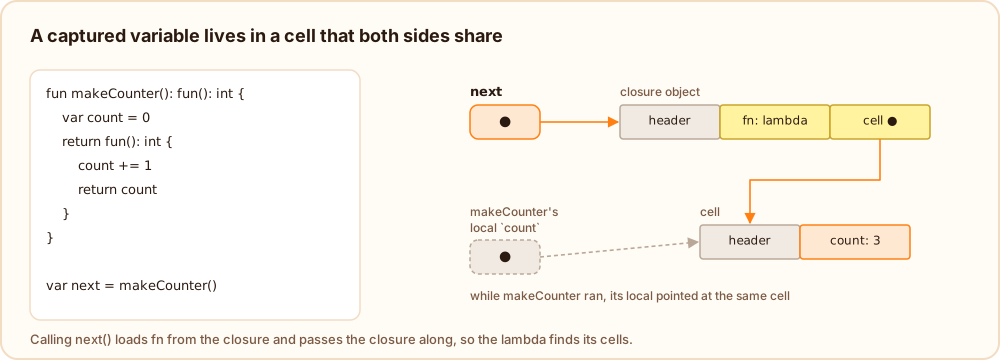
- Variables are shared, not copied: when the outer code changes a variable after creating a lambda, the lambda sees the new value.
- Each iteration of a
forloop has its own loop variable, so lambdas created in a loop each keep their own value. - Inside a struct method, a lambda can use the struct's fields and methods.
fun adder(n: int): fun(int): int {
    return fun(x: int): int {
        return x + n
    }
}

[fun(): int] later = []
for i in 0..3 {
    later.push(fun(): int {
        return i * 10
    })
}
print(adder(5)(10), later[0](), later[2]())Method syntax
Any function can be called as a method of its first argument:
fun isEven(n: int): bool {
    return n % 2 == 0
}

fun shout(s: string): string {
    return upper(s) + "!"
}

print(10.isEven(), "burn".shout(), "a,b".split(",").join("+"))
x.f(y) is the same as f(x, y). It works for your own functions, the built-ins ("burn".upper()) and functions from
imported modules (text.lines() with std/strings). Methods declared in a def struct take precedence over a free
function of the same name.
Generic functions
A function can take type parameters in angle brackets. Burn infers them from the arguments:
fun firstOr<T>(items: [T], fallback: T): T {
    if (len(items) == 0) {
        return fallback
    }
    return items[0]
}

fun mapAll<T, U>(items: [T], f: fun(T): U): [U] {
    [U] out = []
    for x in items {
        out.push(f(x))
    }
    return out
}

print(firstOr([3, 4], 0), firstOr([], "none"), mapAll([1, 2, 3], fun(x: int): string { return "#${x}" }))
See generics for generic types and constraints.
Higher-order helpers
std/list has the usual functions that take functions, all usable as methods:
import "std/list"

var scores = [12, 7, 30, 18]
var passed = scores.filter(fun(s: int): bool { return s >= 10 })
var labels = passed.map(fun(s: int): string { return "${s} pts" })
print(labels, scores.reduce(0, fun(sum: int, s: int): int { return sum + s }))
print(scores.sortBy(fun(s: int): int { return -s }), scores.any(fun(s: int): bool { return s > 25 }))
See lists and collections for find, groupBy, partition, zipWith and the others.
Async functions
async fun runs in the background when it is called and returns a future; await waits for its result. See
async.
async fun fetchSize(name: string): int {
    return len(name) * 100
}

fun main() {
    var a = fetchSize("index")
    var b = fetchSize("about")
    print(await a + await b)
}Recursion and the stack
Deep recursion is fine up to the size of the stack; beyond it, the program stops with
runtime error: stack overflow (recursion is too deep) instead of crashing. Rewrite very deep recursion as a loop.