
Language
Structs and interfaces
Structs
def struct Point(x: int, y: int) {
    fun plus(other: Point): Point {
        return new Point(x + other.x, self.y + other.y)
    }

    static fun origin(): Point {
        return new Point(0, 0)
    }
}

Point p = new Point(1, 2)
var q = p.plus(Point.origin())
print(p, q.x)
The parentheses after the name hold the constructor parameters, and every parameter becomes a field, like a primary constructor in Kotlin. A struct without parameters can leave them out:
def struct Stack {
    [int] items = []

    fun push(n: int) {
        items.push(n)
    }
}

var s = new Stack()
s.push(3)- More fields are declared in the body like variables. A body field needs a default value unless its type has a
zero value:
int,float,bool,string, arrays, maps, optionals and enums. Anything else is an error that suggests making the field a constructor parameter. - Defaults can use the constructor parameters:
string tag = "animal:" + name. - Inside methods, fields and methods can be used directly (
x,plus(...)) or throughself(self.y). privfields and methods can only be used inside the struct.- A normal method can also be called as
Point.plus(p, other).
Creating objects
Objects of a struct are created only with new:
Point p = new Point(1, 2)
var q = new Point(3, 4)
Point(1, 2) and Point { x: 1, y: 2 } are compile errors for a struct ("Point is a struct, so its objects are
created with new"). Plain records defined with def type keep both forms,
Pair(1, "x") and Pair { first: 1, second: "x" }, and new Pair(1, "x") works for them too.
init
fun init() runs after all fields are set. It takes no parameters; values it needs come from the constructor
parameters, which are already fields by then.
def struct Counter(label: string) {
    priv int value = 0
    static var made = 0

    fun init() {
        made += 1
    }

    fun increment(): Counter {
        value += 1
        return self
    }

    fun get(): int {
        return value
    }
}

var c = new Counter("clicks")
var other = new Counter("other")
c.increment().increment()
print(c.label, c.get(), Counter.made)
An init with parameters is an error. When structs extend each other, the init functions run from the top
parent down to the struct being created.
Static members
static funbelongs to the struct and is called asPoint.origin().static varandstatic constvalues live on the struct, not on its objects:static var made = 0is read and written asCounter.made, and inside the struct's own methods asmade. Assigning to astatic constis an error.
Interfaces
def interface Shape {
    fun area(): float
    fun name(): string
}

def struct Rect(w: float, h: float) :: Shape {
    fun area(): float {
        return w * h
    }

    fun name(): string {
        return "rect"
    }
}

fun total(shapes: [Shape]): float {
    var sum = 0.0
    for s in shapes {
        sum += s.area()
    }
    return sum
}
A struct lists the interfaces it implements after ::, separated by commas:
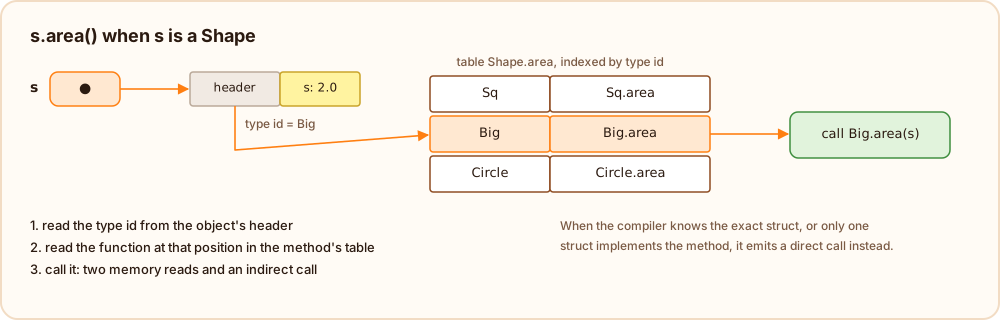
def struct Circle(radius: float) :: Shape, Named { ... }. The compiler checks that every method exists with the
same signature. Interface calls are dispatched through a table indexed by the struct, so they are as cheap as a
normal indirect call.
- An interface only declares methods: it has no fields and no method bodies, and it cannot extend another interface or take type parameters.
- Only structs implement interfaces. To give records, enums or built-in types shared operations, write functions and use method syntax.
s is Rectchecks which struct an interface value holds and narrows it;s as Rectcasts and fails at runtime when it holds another struct.
Extending structs
A struct can extend one other struct and implement any number of interfaces. Which operator you use depends on what comes after it:
| Operator | Used for | Example |
|---|---|---|
: |
a regular struct | def struct Puppy(name: string) : Dog(name, "mixed") { ... } |
:: |
interfaces and abstract structs | def struct Dog(name: string, breed: string) :: Animal(name) { ... } |
Both can be combined, with the : part first: def struct Puppy(name: string) : Dog(name, "mixed") :: Named.
Using the wrong operator is an error with the fix, for example "Shape is an interface, so it is used with
::". A struct extends at most one struct. Static structs and def type records cannot be extended.
Abstract structs
def abstract struct Animal(name: string) {
    int legs = 4
    string tag = "animal:" + name

    abstract fun sound(): string

    fun describe(): string {
        return "${name} says ${sound()}"
    }
}

def struct Dog(name: string, breed: string) :: Animal(name) {
    fun sound(): string {
        return "woof"
    }
}

def struct Bird(name: string) :: Animal(name) {
    fun init() {
        legs = 2
    }

    fun sound(): string {
        return "tweet"
    }

    fun describe(): string {
        return "a bird called ${name}"
    }
}

Dog rex = new Dog("Rex", "lab")
Animal tweety = new Bird("Tweety")
var zoo: [Animal] = [rex, tweety]
for a in zoo {
    print(a.describe(), a.legs)
}
if (tweety is Bird) {
    print("a bird with", tweety.legs, "legs")
}
print(rex)
An abstract struct cannot be created with new ("cannot create an object of abstract struct Animal"). It can
declare abstract fun methods without a body, and every struct that is not abstract must implement all of them
("struct Dog does not implement abstract method Animal.sound"). An abstract struct can extend another
abstract struct.
Extending a regular struct
A regular struct is extended with ::
def struct Puppy(name: string) : Dog(name, "mixed") {
    fun sound(): string {
        return "yip"
    }
}

Dog d = new Puppy("Bit")
print(d.describe(), d.breed)
Puppy is also an Animal, because Dog is one. d.describe() calls Puppy.sound, because calls through a
Dog value run the method of the object's real struct.
Rules for extending
- The parent's constructor arguments go in parentheses after its name. If the parent has parameters, they must be passed.
- A child parameter with the same name and type as an inherited field, like
nameabove, fills that field instead of adding a new one. - The child inherits the parent's fields, methods, interfaces and static members.
- A child can override a method. The signature must match exactly, otherwise it is an error
("
Dog.sounddoes not matchAnimal.sound"). - A child object can be used wherever the parent type is expected, and
rex is Animalis always true. a is Dogchecks for a child struct and smart-castsato it.- Calls through a parent-typed value run the method of the object's real struct. When only one implementation exists, the compiler turns the call into a direct call.
- Printing an object prints its real struct, with the parent's fields first:
Dog { name: "Rex", legs: 4, tag: "animal:Rex", breed: "lab" }. - A child can use the parent's
privfields and methods; code outside the struct family cannot. - Static members belong to the struct that declares them and are shared with its children:
Puppy.countandDog.countare the same variable.
Calling the parent's method
There is no super. An override calls the parent's version by naming the parent and passing self:
def struct Greeter(name: string) {
    fun greet(): string {
        return "hello ${name}"
    }
}

def struct LoudGreeter(name: string) : Greeter(name) {
    fun greet(): string {
        return upper(Greeter.greet(self)) + "!"
    }
}

Greeter g = new LoudGreeter("ada")
print(g.greet())
Greeter.greet(self) runs Greeter's method directly, without looking at the object's real struct, so it does not
call the override again.
Static structs
A static struct has no objects. It groups functions and values under one name:
def static struct Geometry {
    const unit = 1.0
    var calls = 0

    fun square(x: float): float {
        calls += 1
        return x * x * unit
    }
}

print(Geometry.square(3), Geometry.calls)
Geometry.calls = 10
Every function in a static struct is static, and its values are used as Geometry.calls. var values can be
assigned, const values cannot. new Geometry() is an error ("Geometry is a static struct and has no
objects"). The standard library's Math, JSON and HTTP are static structs.
Functions on a single object
A function can be added to one object, without changing its struct:
def struct Robot(name: string) {
    int battery = 100

    fun status(): string {
        return "${name}: ${battery}%"
    }
}

Robot rex = new Robot("Rex")
Robot bolt = new Robot("Bolt")

rex.fetch(thing: string): string {
    battery -= 10
    return "${name} fetches the ${thing}, ${status()}"
}

print(rex.fetch("ball"))
print(bolt.status())- Inside the function,
self, the object's fields and the struct's methods are available. The local variables of the surrounding function are not, the same as in lambdas, and neither are private members. - The compiler tracks the function from that line on, like a smart cast. It can be called on that variable
afterwards, but not on other objects of the same struct (
bolt.fetch(...)is an error: "Robot has no methodfetch"). - It is not available on paths where it might not have been added. If it is only added inside an
if, calling it after theifis an error ("fetchis not available here"). - Assigning another object to the variable forgets the function.
- The name must not clash with a field or method of the struct.
Equality and printing
== compares two objects field by field, like records: two new Point(1, 2) are equal. It does not check whether
two variables hold the same object. print and string templates show an object as its struct name and fields,
Point { x: 1, y: 2 }; a toString method does not change that, so call it explicitly when you want your own
format.
Destroying objects
destroy name() destroys the object in a variable. If the struct, or a struct it extends, defines
fun destroy(...), that function runs first and gets the arguments:
def struct File(path: string) {
    bool open = true

    fun destroy(reason: string) {
        open = false
        print("closing", path, "because", reason)
    }
}

File f = new File("data.txt")
destroy f("done")
f = new File("next.txt")
print(f.path)- Without a
destroyfunction,destroy f()takes no arguments; passing some is an error. - A destructor cannot be called directly:
f.destroy()is an error. - After
destroy f(...), usingfis a compile error ("fwas destroyed on line 11 and can no longer be used") until a new object is assigned to it. - When the compiler can't see it, for example through another variable that points to the same object or after
the object was destroyed inside another function, using the object is a runtime error: "this object was
destroyed and can no longer be used".
Printing such an object shows
<destroyed Session>, with its struct name. - Destroying an object twice is a runtime error: "this object was already destroyed".
- Only struct objects stored in variables can be destroyed.
The runtime check only exists in programs that use destroy, so other programs don't pay for it.
Classes
def class no longer exists. It is a compile error ("classes are now structs") that suggests
def struct Name(...) and new Name(...). See migrating classes.